
Packaging buyers want products that look distinctive on a crowded shelf, but printers must still control production cost, delivery time and changeover complexity. Cold foil offers a useful balance. It creates reflective metallic areas without relying on a heated stamping die, so it can support fine graphics, larger decorative zones and designs that combine metallic detail with printed color. For Russian packaging printers serving cosmetics, confectionery, wine and spirits, pharmaceuticals, gifts and premium retail products, this flexibility can turn a conventional carton into a higher-value item. The opportunity is not limited to gold or silver decoration. When transparent or colored inks are printed over a metallic layer, designers can develop a broader palette while keeping the visual brightness that attracts attention. The process therefore belongs in a commercial strategy, not only in a list of machine features.
How a screen-printing-based cold foil line works
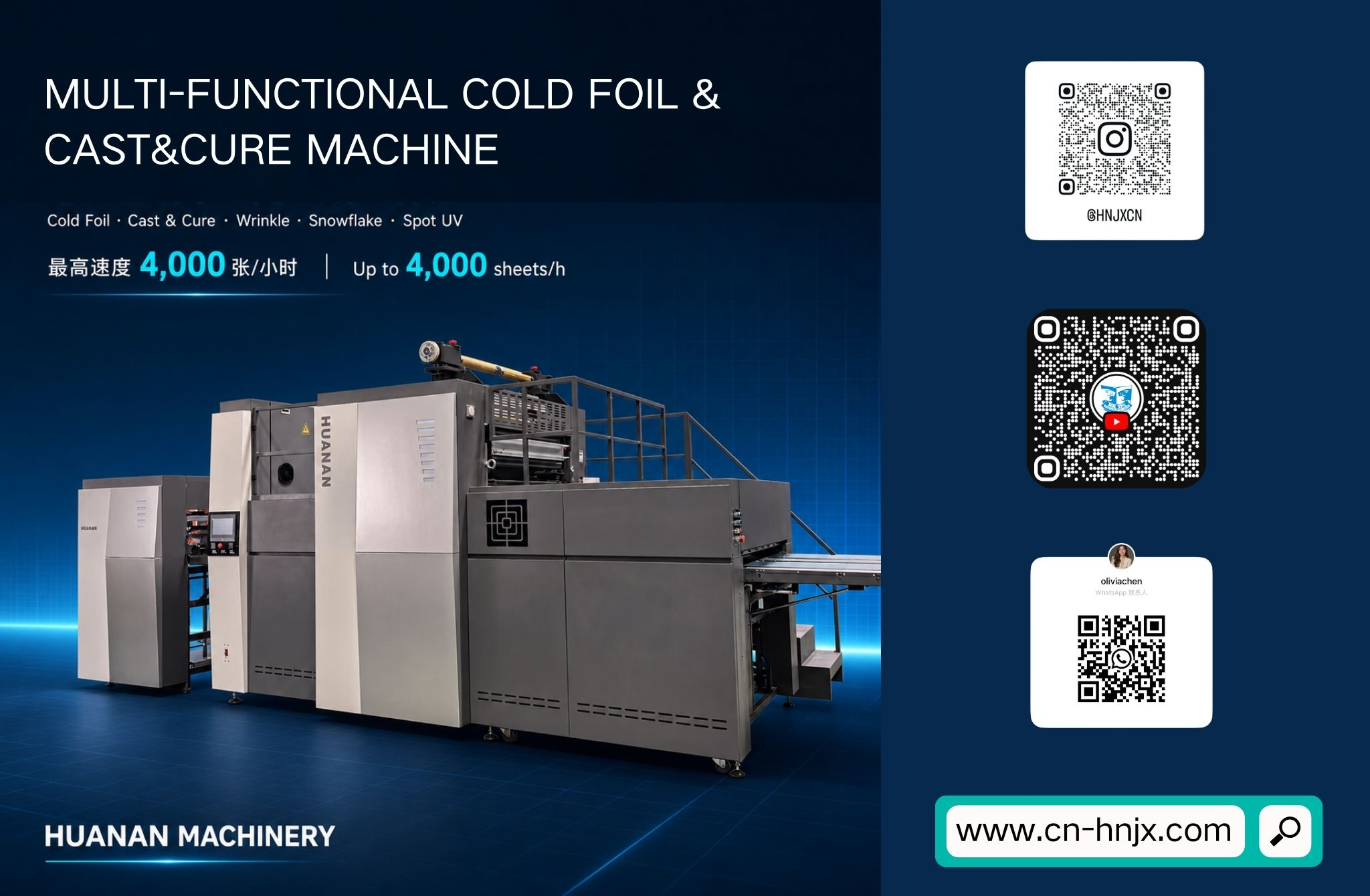
In a typical sheet-fed workflow, the design first receives a precisely registered UV-curable adhesive or varnish through an automatic screen printing unit. Foil is laminated to the printed sheet, UV energy cures the selected image area, and the carrier film is separated so that the metallic layer remains where required. Stable feeding, registration, coating control, curing energy, web tension and delivery all influence the result. Huanan’s multi-functional cold foil and Cast&Cure equipment can be connected to an automatic screen printing machine to form an integrated line. The same platform can support cold foil, Cast&Cure, spot UV, snowflake and wrinkle effects. This matters to a printer that wants several sellable finishing processes without purchasing a completely separate line for every effect. Spot UV can also be used independently when no foil or special texture is required.
Applications that fit the Russian packaging market
The strongest applications are jobs where decoration supports a clear price premium or brand objective. Cosmetic cartons can use fine metallic lines around logos, borders and ingredient panels. Confectionery and food packaging can emphasize a product name, flavor cue or seasonal graphic. Wine and spirits boxes can combine metallic motifs with tactile varnish to communicate craftsmanship. Pharmaceutical cartons may use controlled decorative areas to distinguish a premium range, although all regulated text and barcode requirements must remain fully legible. Gift bags, notebooks, invitations and cultural products provide additional work outside folding cartons. A printer should begin with the customer segments already present in its order book. The best first jobs are not necessarily the most elaborate; they are repeatable designs with a visible benefit, manageable coverage and enough volume to establish dependable production settings.
Production variables to test before commercial launch
Successful cold foil production depends on the complete process window. Substrate surface energy, coating absorption, adhesive deposit, mesh specification, squeegee condition, foil compatibility, UV dose, nip pressure and ambient conditions should be tested together. Paperboard that appears similar may behave differently because of its coating and porosity. Printers should qualify representative coated paper and board rather than assuming one recipe will work for every stock. Registration should be checked across the full sheet and throughout the run, especially when metallic detail aligns with offset printing. Operators should also monitor foil wrinkles, incomplete transfer, edge definition and blocking. A documented sample library is valuable: record the substrate, consumables, machine settings, speed and observed result. This turns initial trials into reusable production knowledge and makes future quotations more accurate.
Choosing the appropriate sheet format and output level
Huanan lists LT-106-3Y, LT-130-3Y and LT-1450-3Y configurations for different sheet formats. Published maximum sheet sizes are 1100 x 780 mm, 1320 x 880 mm and 1500 x 1050 mm respectively, with corresponding maximum film widths of 1050 mm, 1300 mm and 1450 mm. Paper thickness is listed at 90-450 g/m2, while cold foil work is listed at 157-450 g/m2. The appropriate model should be selected from actual imposed sheet sizes, board caliper, upstream press format and expected job mix, not from maximum size alone. Published delivery speed varies by model and process. Real production output will also depend on artwork, foil coverage, substrate, curing and handling. A useful buying review compares at least twenty recent or forecast jobs against the machine’s usable format and process window.
Controlling foil consumption and operating cost
Foil is a visible operating cost, so web utilization deserves the same attention as press speed. The Huanan cold foil system uses three shafts and can accommodate rolls of different diameters. Its skip and pull-back functions are designed to reduce unused foil between sheets and within a sheet, depending on the image layout. Costing should include foil width, repeat length, image coverage, setup waste, adhesive or varnish, screens, UV energy, labor and rejected sheets. Printers can improve utilization by grouping metallic images intelligently during imposition and by selecting the narrowest practical foil web for the design. The commercial team should quote finishing as a value-adding process while production estimates it as a measurable set of consumables and machine time. That combination protects margin and gives customers a clear reason to choose the effect.
A sensible route from samples to regular production
Start with a structured pilot. Select two or three substrates, several foil patterns and artwork that represents fine lines, solid areas and reversed text. Establish acceptance criteria for registration, adhesion, gloss, edge quality and downstream converting. Produce physical samples for sales teams and brand customers, but keep a duplicate set with recorded settings for production. Train operators in both normal adjustment and fault diagnosis, including safe film handling and UV-system procedures. Then introduce a controlled group of commercial jobs before promising the process for every substrate and design. Huanan’s touch-screen control, fault prompts, electronically adjusted foil pressure and adjustable UV energy are intended to support consistent operation, but process discipline remains essential. A machine creates capacity; standardized work turns that capacity into dependable customer value.
Building a competitive finishing service
Cold foil is most effective when sold as part of a finishing portfolio. A Russian packaging printer can offer a bright metallic image for one product, a holographic Cast&Cure pattern for another, selective gloss for a restrained premium effect, and snowflake or wrinkle texture for seasonal work. Designers can compare these effects during sampling instead of forcing every brief into the same technique. The practical objective is to shorten the path from concept to approved sample while using one coordinated production platform. Printers evaluating a line should send representative sheets, artwork, target effects and expected volumes to the equipment supplier. A trial based on real jobs reveals more than a generic demonstration and helps define configuration, consumables, training and acceptance standards before installation.
Call to Action
Planning a cold foil, spot UV or Cast&Cure project? Send Huanan Machinery your sheet size, substrate, artwork, target effect and expected production volume to discuss a suitable line configuration and sample test.
Post time: Jul-06-2026


